4-Week At-Home Workout Plan: Minimal Equipment + Daily Stretch
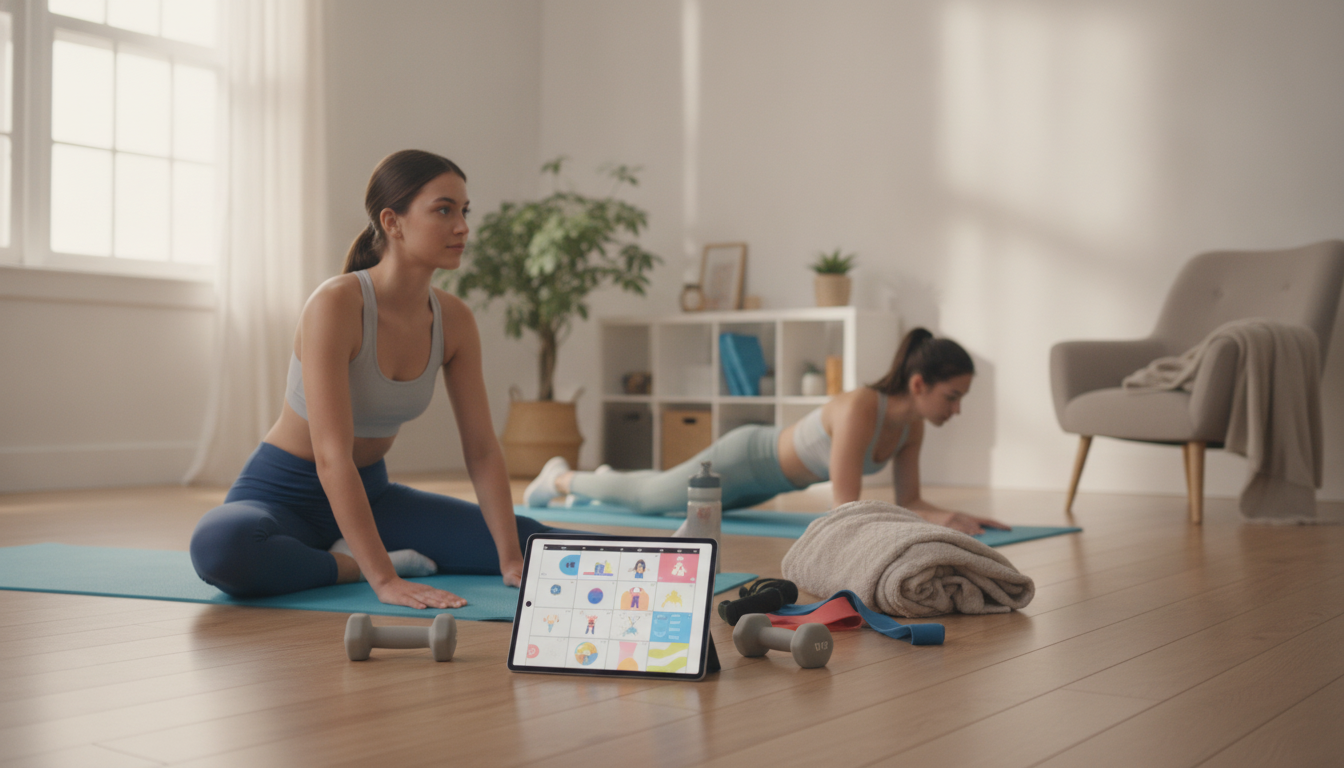
Fit at Home: A 4-Week Minimal-Equipment Workout Plan with Daily Stretches
A consistent home routine can build strength, improve conditioning, and reduce stiffness without a full gym setup. This 4-week plan uses simple movements, short sessions, and a repeatable weekly structure so progress is easy to track. Expect a balanced mix of strength, core, low-impact cardio options, and daily stretches designed to fit into busy schedules and small spaces.
Who this plan fits (and what “minimal equipment” means)
This plan is built for beginners through intermediate exercisers who want a structured month of daily guidance at home—without needing a rack of machines. It works especially well if you stay motivated by checklists, clear daily targets, and built-in recovery days.
- Minimal equipment can be as simple as a chair/bench, a mat (or towel), light dumbbells (or a backpack), and an optional resistance band.
- Low-impact friendly: most sessions can be done without jumping and can be modified to reduce joint stress.
- Small-space ready: movements are chosen to fit typical living-room footprints.
How to use the 4-week structure for steady progress
The weekly schedule is straightforward: 5 workout days + 1 mobility day + 1 rest day. If your calendar is tight, reduce to 4 workout days by skipping Day 6 (the circuit) and keeping the mobility day.
- Progression: each week, add a small challenge—more reps, one extra set, slightly less rest, or a bit more load.
- Intensity guide: on strength sets, stop with 2–3 clean reps “in the tank” to keep form solid.
- Tracking: write down sets/reps, effort (1–10), and substitutions so you can repeat success and avoid guesswork.
Simple progression options (choose one each week)
| Goal | Week-to-week change | Example |
|---|---|---|
| More volume | Add 1 set to 2 exercises | Push-ups: 3 sets → 4 sets |
| More reps | Add 1–2 reps per set | Squats: 10 reps → 12 reps |
| More density | Reduce rest by 10–15 seconds | Rest: 60s → 45–50s |
| More load | Slightly heavier weight/backpack | Backpack: 10 lb → 12–15 lb |
For general weekly activity targets (including strength training guidance), reference the Physical Activity Guidelines for Americans and the CDC physical activity basics.
Weekly plan template (repeat for 4 weeks)
Repeat this same weekly rhythm for four weeks. The goal is to get better at the basics—then nudge difficulty up gradually.
| Day | Focus | Time | Notes |
|---|---|---|---|
| 1 | Full-body strength | 25–40 min | Prioritize form; steady tempo |
| 2 | Core + conditioning | 20–35 min | Low-impact options available |
| 3 | Lower-body strength | 25–40 min | Add load with backpack/dumbbells |
| 4 | Mobility + stretch | 15–25 min | Keep intensity easy |
| 5 | Upper-body strength | 25–40 min | Use incline modifications as needed |
| 6 | Circuit conditioning | 20–35 min | Work/rest intervals |
| 7 | Rest | — | Optional easy walk or stretching |
What each day looks like (simple template)
- Day 1 – Full-body strength: squat pattern, push, pull/row substitute, core finisher.
- Day 2 – Core + low-impact conditioning: intervals using marching, step-ups, shadow boxing, or brisk circuits.
- Day 3 – Lower-body strength + glutes: hinges, lunges, calf work, posterior-chain focus.
- Day 4 – Mobility and stretch: hips, hamstrings, thoracic spine, shoulders, ankles (lighter day).
- Day 5 – Upper-body strength + core: push variations, shoulder work, row substitute, carries or holds.
- Day 6 – Conditioning + total-body circuit: timed rounds with scalable intensity (impact optional).
- Day 7 – Rest or gentle walk: light movement to support recovery and routine consistency.
Daily workout building blocks (moves and substitutions)
Instead of chasing dozens of exercises, rotate a few foundational patterns. This keeps workouts repeatable—so improvements are easy to notice.
- Squat pattern: bodyweight squats, chair squats, goblet squats with a dumbbell/backpack.
- Hinge pattern: hip hinges, Romanian deadlifts (dumbbells/backpack), glute bridges.
- Push pattern: wall push-ups → incline push-ups → floor push-ups; use tempo to increase difficulty.
- Pull substitute at home: band rows, backpack rows, or gentle isometric doorframe rows.
- Core basics: dead bugs, planks, side planks, bird dogs; breathe slowly and stay controlled.
- Conditioning options: step-ups, marching high knees, low-impact jacks, shadow boxing, brisk stair walks.
Quick substitutions to match your level
| If this feels too hard… | Try this | If this feels too easy… |
|---|---|---|
| Push-ups | Hands on counter or wall | Slow 3-second lower + pause |
| Lunges | Split squats holding a chair | Add backpack load |
| Plank | Knees-down plank | Longer holds or side plank |
| Step-ups | Lower step height | Faster pace or longer interval |
Daily stretching routine (10–15 minutes)
Safety, recovery, and realistic expectations over 4 weeks
For exercise form references and movement ideas, the ACE exercise library is a helpful starting point.
A structured option: downloadable plan with daily workouts and stretches
If you prefer a printable-style format that removes decision fatigue, the Fit at Home: 4-Week Workout Plan | Minimal Equipment Exercise Guide PDF lays out each day’s session, sets, and stretches in one place—built around the same repeatable weekly rhythm.
For extra support on the mental side of staying consistent, consider pairing training with simple calming routines like Break the Tension: Stress Relief Techniques or a more comprehensive toolkit like The Anxiety Relief Bundle: A Path to Calm.
FAQ
How long should each workout take for a 4-week home plan?
Most sessions fit into 20–40 minutes including a brief warm-up, with a shorter mobility day around 15–25 minutes. If you have extra time, add one set to a couple movements or an extra conditioning round.
What if there’s no equipment at all?
Use bodyweight progressions like incline push-ups, tempo squats, split squats, glute bridges, and planks. Make it harder with slower reps, extra sets, and shorter rest times.
How many rest days are needed each week?
One full rest day plus one lighter mobility day works well for many people. If soreness is high or sleep is limited, add an extra easy day and resume progression gradually.












Leave a comment